50 Metaphors For Colors
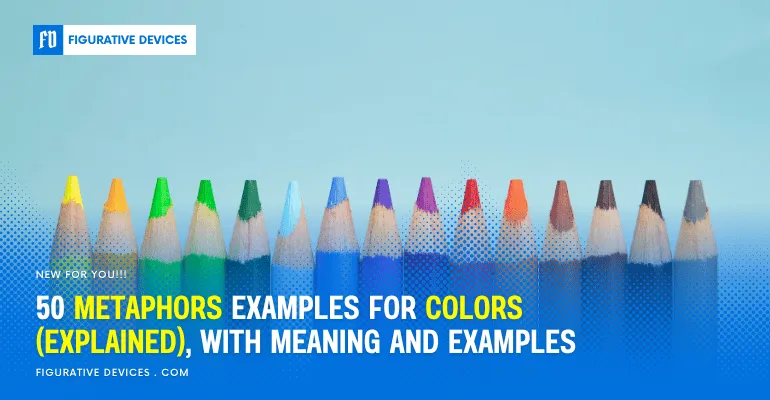

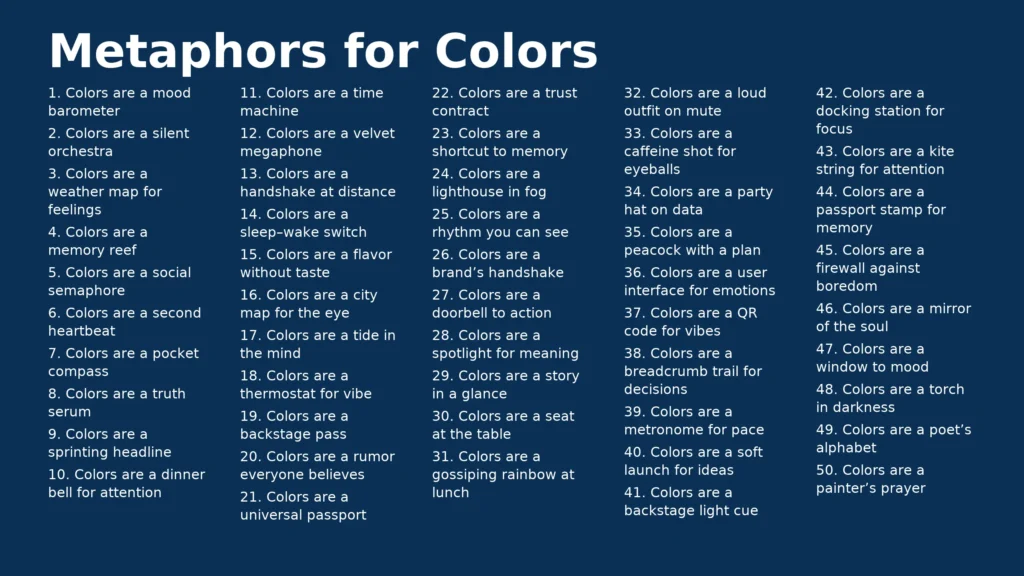
Colors steer emotion, set pace, and signal intent. This article stacks tight metaphors so you can speak about hue, tone, and saturation with precision in branding, writing, design, and everyday talk.
For Further deep down for each color go: green, red, black, white, blue, brown, orange, purple, yellow.
20 Metaphors For Colors
Colors are a mood barometer.
Meaning and when to use: Use to show quick emotional weather.
Example: I softened the lobby because colors are a mood barometer.
Other Ways to Say: vibe gauge, feeling meter, tone index, aura scale, sentiment dial
Colors are a silent orchestra.
Meaning and when to use: Use for harmony, balance, and layered signals.
Example: The homepage sings; colors are a silent orchestra.
Other Ways to Say: harmony set, chord palette, cadence suite, tone ensemble, rhythm array
Colors are a weather map for feelings.
Meaning and when to use: Use when moods shift across spaces.
Example: In our offices, colors are a weather map for feelings.
Other Ways to Say: emotion chart, climate grid, mood atlas, affect map, vibe radar
Colors are a memory reef.
Meaning and when to use: Use when shades anchor recall.
Example: For the launch, colors are a memory reef.
Other Ways to Say: recall anchor, mnemonic shoal, memory mooring, cue bank, imprint shelf
Colors are a social semaphore.
Meaning and when to use: Use to signal norms and roles.
Example: At events, colors are a social semaphore.
Other Ways to Say: status flag, cue pennant, role marker, signal pennon, protocol tag
Colors are a second heartbeat.
Meaning and when to use: Use to show energy beneath actions.
Example: The brand breathes; colors are a second heartbeat.
Other Ways to Say: pulse layer, cadence core, rhythm underbeat, tempo echo, vitality thread
Colors are a pocket compass.
Meaning and when to use: Use for guiding attention.
Example: On dashboards, colors are a pocket compass.
Other Ways to Say: focus pointer, attention needle, gaze guide, orientation cue, path arrow
Colors are a truth serum.
Meaning and when to use: Use when shade exposes intent.
Example: In packaging, colors are a truth serum.
Other Ways to Say: honesty tint, clarity wash, candor glaze, sincerity tone, open-chroma
Colors are a sprinting headline.
Meaning and when to use: Use for fast impact.
Example: For ads, colors are a sprinting headline.
Other Ways to Say: instant lead, front-line cue, quick banner, flash tag, prime callout
Colors are a dinner bell for attention.
Meaning and when to use: Use to summon focus on demand.
Example: In wayfinding, colors are a dinner bell for attention.
Other Ways to Say: focus chime, notice ring, alert clang, gaze bell, cue clangor
Colors are a time machine.
Meaning and when to use: Use for nostalgia or future-casting.
Example: For the retro line, colors are a time machine.
Other Ways to Say: memory portal, era switch, epoch key, recall gate, vintage lever
Colors are a velvet megaphone.
Meaning and when to use: Use when soft yet loud matters.
Example: In luxury, colors are a velvet megaphone.
Other Ways to Say: plush amplifier, gentle shout, soft spotlight, silky callout, toned trumpet
Colors are a handshake at distance.
Meaning and when to use: Use for first-contact impressions.
Example: On storefronts, colors are a handshake at distance.
Other Ways to Say: remote greeting, far hello, approach signal, welcome cue, first-touch tone
Colors are a sleep–wake switch.
Meaning and when to use: Use for arousal or calm.
Example: In clinics, colors are a sleep–wake switch.
Other Ways to Say: arousal toggle, calm lever, energy slider, rest trigger, pace switch
Colors are a flavor without taste.
Meaning and when to use: Use when describing sensory crossovers.
Example: In poetry, colors are a flavor without taste.
Other Ways to Say: synesthetic cue, cross-sense hint, taste-alike tone, savor echo, sense blend
Colors are a city map for the eye.
Meaning and when to use: Use to plan visual routes.
Example: In UI, colors are a city map for the eye.
Other Ways to Say: gaze grid, route plan, visual atlas, street of sight, path schema
Colors are a tide in the mind.
Meaning and when to use: Use for ebb and flow of focus.
Example: During talks, colors are a tide in the mind.
Other Ways to Say: focus swell, attention drift, mental current, flow surge, ebb rhythm
Colors are a thermostat for vibe.
Meaning and when to use: Use to set warmth or coolness of mood.
Example: For cafés, colors are a thermostat for vibe.
Other Ways to Say: tone regulator, ambiance dial, warmth setpoint, climate knob, mood control
Colors are a backstage pass.
Meaning and when to use: Use to access hidden layers of meaning.
Example: In exhibits, colors are a backstage pass.
Other Ways to Say: access tag, inner-door cue, behind-scenes key, entry badge, insider tone
Colors are a rumor everyone believes.
Meaning and when to use: Use to show persuasive bias.
Example: In markets, colors are a rumor everyone believes.
Other Ways to Say: bias cue, suggestive hint, persuasive tint, crowd signal, echo tone
10 “Best” Metaphors For Colors
Colors are a universal passport.
Meaning and when to use: Use for cross-culture clarity.
Example: Globally, colors are a universal passport.
Other Ways to Say: shared visa, borderless cue, common token, open pass, global sign
Colors are a trust contract.
Meaning and when to use: Use for credibility signals.
Example: For fintech, colors are a trust contract.
Other Ways to Say: reliability badge, assurance seal, promise tint, faith tag, pledge tone
Colors are a shortcut to memory.
Meaning and when to use: Use to improve recall.
Example: On labels, colors are a shortcut to memory.
Other Ways to Say: recall lane, memory hop, cue sprint, imprint path, quick trigger
Colors are a lighthouse in fog.
Meaning and when to use: Use for guidance amid confusion.
Example: In crisis decks, colors are a lighthouse in fog.
Other Ways to Say: beacon cue, clarity beam, guide flare, safe mark, hazard light
Colors are a rhythm you can see.
Meaning and when to use: Use to pace reading.
Example: In long pages, colors are a rhythm you can see.
Other Ways to Say: scan beat, cadence cue, tempo line, pacing grid, reading meter
Colors are a brand’s handshake.
Meaning and when to use: Use for identity.
Example: On packaging, colors are a brand’s handshake.
Other Ways to Say: identity grip, signature cue, logo echo, mark touch, symbol greet
Colors are a doorbell to action.
Meaning and when to use: Use for calls-to-action.
Example: On buttons, colors are a doorbell to action.
Other Ways to Say: action chime, tap lure, click cue, trigger bell, response ring
Colors are a spotlight for meaning.
Meaning and when to use: Use for emphasis.
Example: In reports, colors are a spotlight for meaning.
Other Ways to Say: focus beam, meaning lamp, highlight ray, emphasis glow, signal light
Colors are a story in a glance.
Meaning and when to use: Use for instant narrative.
Example: In posters, colors are a story in a glance.
Other Ways to Say: glance tale, instant arc, snap plot, swift yarn, flash narrative
Colors are a seat at the table.
Meaning and when to use: Use for inclusion cues.
Example: In hiring pages, colors are a seat at the table.
Other Ways to Say: welcome sign, open chair, join cue, entry token, invite signal
5 “funny” Metaphors For Colors
Colors are a gossiping rainbow at lunch.
Meaning and when to use: Use for playful chatter energy.
Example: Our feed pops; colors are a gossiping rainbow at lunch.
Other Ways to Say: chatty spectrum, rumor tint, banter glaze, noodle-talk tone, snack-time hue
Colors are a loud outfit on mute.
Meaning and when to use: Use when design shouts quietly.
Example: Even whispering, colors are a loud outfit on mute.
Other Ways to Say: quiet roar, hush-shout, soft blare, gentle blast, toned boom
Colors are a caffeine shot for eyeballs.
Meaning and when to use: Use for wakefulness.
Example: Monday banners need it; colors are a caffeine shot for eyeballs.
Other Ways to Say: alert sip, focus jolt, gaze espresso, vision perk, optic buzz
Colors are a party hat on data.
Meaning and when to use: Use to make charts lively.
Example: My dashboard smiles; colors are a party hat on data.
Other Ways to Say: festive tint, merry overlay, cheerful tone, lively glaze, playful wrap
Colors are a peacock with a plan.
Meaning and when to use: Use for flashy strategy.
Example: The pitch strutted; colors are a peacock with a plan.
Other Ways to Say: showy scheme, bold display, flaunt cue, flair guide, strut signal
10 “New” Metaphors For Colors
Colors are a user interface for emotions.
Meaning and when to use: Use for intuitive feeling control.
Example: In the app, colors are a user interface for emotions.
Other Ways to Say: feeling dashboard, mood UI, affect panel, emotive screen, sentiment surface
Colors are a QR code for vibes.
Meaning and when to use: Use for quick scanning of mood.
Example: At events, colors are a QR code for vibes.
Other Ways to Say: scannable cue, instant tag, coded tone, quick key, snap signal
Colors are a breadcrumb trail for decisions.
Meaning and when to use: Use to guide steps.
Example: In checkout, colors are a breadcrumb trail for decisions.
Other Ways to Say: choice path, step markers, route crumbs, guidance line, follow cue
Colors are a metronome for pace.
Meaning and when to use: Use to control tempo.
Example: For workouts, colors are a metronome for pace.
Other Ways to Say: tempo tick, rhythm click, cadence beat, pace marker, timing cue
Colors are a soft launch for ideas.
Meaning and when to use: Use when easing concepts in.
Example: In change decks, colors are a soft launch for ideas.
Other Ways to Say: gentle entry, cushioned reveal, subtle debut, easing cue, glide-in tone
Colors are a backstage light cue.
Meaning and when to use: Use for behind-the-scenes timing.
Example: During demos, colors are a backstage light cue.
Other Ways to Say: timing lamp, cue glow, stage hint, trigger light, show signal
Colors are a docking station for focus.
Meaning and when to use: Use to anchor attention.
Example: In study rooms, colors are a docking station for focus.
Other Ways to Say: focus berth, anchor bay, attention pier, mooring point, gaze cradle
Colors are a kite string for attention.
Meaning and when to use: Use for gentle control.
Example: I guide readers; colors are a kite string for attention.
Other Ways to Say: tether line, guiding cord, hold thread, steer strand, lead filament
Colors are a passport stamp for memory.
Meaning and when to use: Use to mark experiences.
Example: Travel journals glow; colors are a passport stamp for memory.
Other Ways to Say: memory seal, recall mark, imprint stamp, trip token, journey tag
Colors are a firewall against boredom.
Meaning and when to use: Use to block dullness.
Example: In training, colors are a firewall against boredom.
Other Ways to Say: dullness shield, apathy guard, fatigue wall, yawn blocker, lag barrier
5 “Old” Metaphors For Colors
Colors are a mirror of the soul.
Meaning and when to use: Use for deep character readouts.
Example: In portraits, colors are a mirror of the soul.
Other Ways to Say: inner lens, spirit glass, heart reflection, core reveal, essence view
Colors are a window to mood.
Meaning and when to use: Use for open emotional views.
Example: In diaries, colors are a window to mood.
Other Ways to Say: feeling pane, emotion view, mood frame, open sight, clear outlook
Colors are a torch in darkness.
Meaning and when to use: Use for guidance and hope.
Example: In setbacks, colors are a torch in darkness.
Other Ways to Say: guide flame, hope light, path lamp, beacon spark, wayfinder glow
Colors are a poet’s alphabet.
Meaning and when to use: Use for expressive building blocks.
Example: On canvases, colors are a poet’s alphabet.
Other Ways to Say: lyric set, verse letters, muse glyphs, stanza tiles, image phonemes
Colors are a painter’s prayer.
Meaning and when to use: Use for devotion to craft.
Example: In studios, colors are a painter’s prayer.
Other Ways to Say: studio hymn, canvas litany, palette vow, brush creed, art supplication